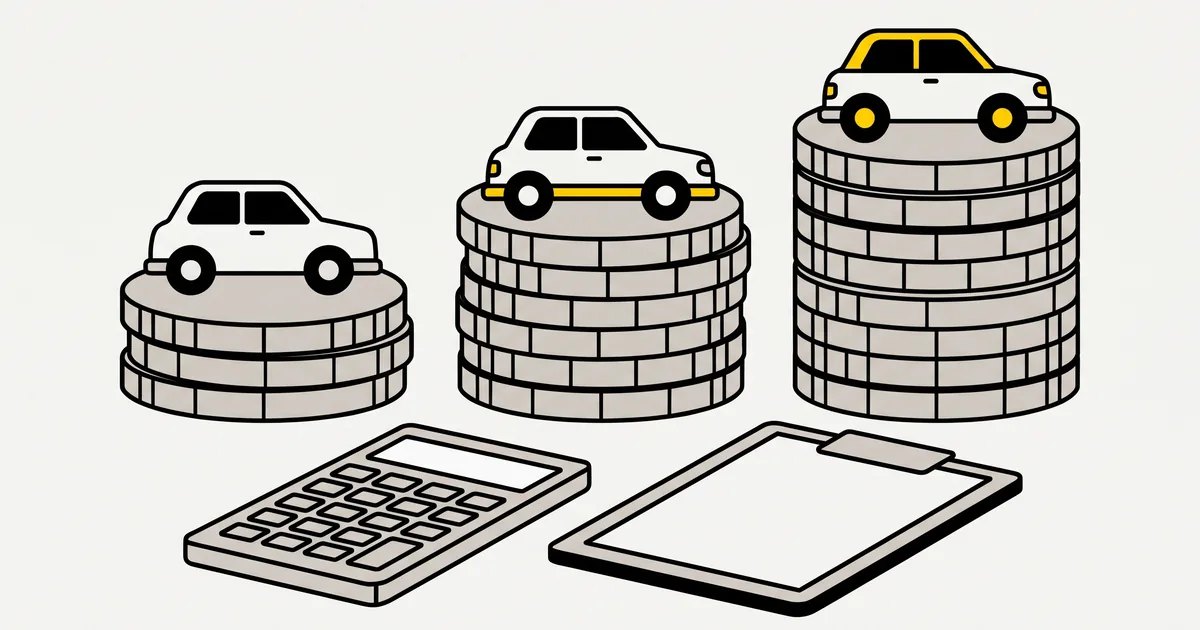
Short answer: In our 2027 worked budgets, opening a small car rental business with financed cars takes about $36,000 in cash for 3 cars, about $128,000 for 10 cars and about $348,000 for a staffed 25-car operation, including three months of running costs. Buying the cars outright raises those numbers sharply. The single biggest line is always the vehicles, followed by insurance and the cash you hold back for slow months.
Search results for this question give ranges from $10,000 to $500,000, which tells you nothing. Below are three budgets with every line shown, so you can replace our assumptions with quotes from your own lender, insurer and landlord.
Key takeaways
- Vehicles take 55–65% of your opening cash when financed (down payments plus purchase taxes), and far more if you pay cash. A new compact car averaged $27,977 in the US in September 2026, according to Cox Automotive's Kelley Blue Book report.
- Insurance is the number that surprises people. Get at least two commercial quotes before you buy a single car.
- Hold three months of fixed costs in reserve. Your first bookings arrive slower than your first loan payment.
- Software is now a small line. A booking website, contracts and payments can cost $0 to $129 a month.
- Break-even depends on utilisation. In our 10-car example, each car must earn about $1,100 a month, roughly 20 rental days at $55.
The assumptions behind every budget
These are the inputs we used. Each one is either a published figure or clearly marked as our assumption.
| Input | Value used | Where it comes from |
|---|---|---|
| Vehicle price | $28,000 per compact car | Compact-car average transaction price $27,977, Cox Automotive / Kelley Blue Book, September 2026 |
| Financing | 20% down, 48 months, 8% APR: about $547 a month per car | Our assumption; ask your lender |
| Purchase taxes, title and plates | 8% of the price, $2,240 per car | Our assumption; some US states exempt or tax rental fleets differently |
| Insurance | $3,000 per car per year, paid quarterly | Our assumption; commercial rental cover varies widely |
| Maintenance, tyres, cleaning | $100 per car per month | Our assumption |
| GPS tracker | $100 per car once, $15 a month service | Our assumption |
| Card processing | 3% of revenue | Our assumption, typical of online card pricing |
| Software | $0, $29 or $129 a month | CarCEO's published plans, depending on fleet size |
If you are buying used cars, lower the vehicle price and raise the maintenance line. Manheim's wholesale index shows used prices are not falling fast: its October 2026 reading was 206.8, up 2% on a year earlier, and former rental cars were 1.9% dearer than in October 2025.
Budget 1: three cars, run from home
A side business or a first step after hosting on a marketplace. No lot, no staff; you deliver cars or meet customers.
| One-off cost | Amount |
|---|---|
| Down payments on 3 cars | $16,800 |
| Purchase taxes, title and plates | $6,720 |
| Insurance, first quarter | $2,250 |
| Business set-up: entity, licences, accountant | $1,000 |
| GPS trackers | $300 |
| Cleaning kit, key box, phone | $800 |
| Reserve: 3 months of fixed costs | $8,295 |
| Cash needed to open | about $36,165 |
Monthly fixed costs are about $2,765: three loan payments ($1,641), insurance ($750), a maintenance reserve ($300), GPS service ($45) and software ($29). Card processing comes on top, as a share of whatever you earn.
Budget 2: ten cars and a small lot
The point where most operators move from "side business" to "company". You need a place to park, wash and hand over cars.
| One-off cost | Amount |
|---|---|
| Down payments on 10 cars | $56,000 |
| Purchase taxes, title and plates | $22,400 |
| Insurance, first quarter | $7,500 |
| Business set-up and legal | $2,000 |
| Lot: two months' deposit plus first month at $1,500 | $4,500 |
| GPS trackers | $1,000 |
| Equipment: pressure washer, vacuum, signage, laptop | $3,000 |
| Reserve: 3 months of fixed costs | $31,947 |
| Cash needed to open | about $128,347 |
Monthly fixed costs are about $10,649: loans ($5,470), insurance ($2,500), lot rent ($1,500), maintenance ($1,000), GPS ($150) and software ($29 on a 10-vehicle plan).
Budget 3: twenty-five cars with two staff
A staffed counter, longer opening hours and some corporate or insurance-replacement work.
| One-off cost | Amount |
|---|---|
| Down payments on 25 cars | $140,000 |
| Purchase taxes, title and plates | $56,000 |
| Insurance, first quarter | $18,750 |
| Set-up, legal and contracts review | $4,000 |
| Premises: deposit plus first month at $4,000 | $12,000 |
| GPS trackers | $2,500 |
| Fit-out and equipment | $8,000 |
| Reserve: 3 months of fixed costs | $106,287 |
| Cash needed to open | about $347,537 |
Monthly fixed costs are about $35,429: loans ($13,675), staff ($7,500 for two people, our assumption), insurance ($6,250), premises ($4,000), maintenance ($2,500), marketing ($1,000), GPS ($375) and software ($129 for unlimited vehicles).
Financed vs bought outright
The budgets above assume you finance the cars. Paying cash removes the loan payments but multiplies the opening cheque.
| Fleet size | Cash to open, financed | Cash to open, cars bought outright | Monthly fixed costs, financed | Monthly fixed costs, owned |
|---|---|---|---|---|
| 3 cars | about $36,000 | about $98,000 | $2,765 | $1,124 |
| 10 cars | about $128,000 | about $336,000 | $10,649 | $5,179 |
| 25 cars | about $348,000 | about $867,000 | $35,429 | $21,754 |
The "owned" column uses the full vehicle price instead of the down payment and keeps the same three-month reserve rule, which is smaller because there are no loan payments. Owning lowers your break-even, but ties up cash you may need for the next five cars.
Worked example: what each car must earn
Take Budget 2. Monthly fixed costs of $10,649 across 10 cars is about $1,065 per car. Add 3% card processing and each car needs about $1,100 a month in revenue just to cover costs, before you pay yourself.
| Daily rate | Rental days needed per car per month | Utilisation needed (30.4-day month) |
|---|---|---|
| $45 | 24.4 | 80% |
| $55 | 20.0 | 66% |
| $65 | 16.9 | 56% |
| $75 | 14.7 | 48% |
For context, Hertz reported global vehicle utilisation of 81% and revenue of $1,385 per car per month for 2025 in its fourth-quarter earnings release. Hertz buys cars far cheaper than you will and runs airport counters every day of the year, so treat that as a ceiling, not a target. At 50–60% utilisation, a new operator with financed new cars needs a daily rate between about $60 and $72 to break even, or cheaper cars.
Country notes for 2027
- United States: rental-car taxes and fees are set by states, counties and airports; our state-by-state rental tax guide explains how they stack up. Check whether your state taxes the vehicle purchase or the rental.
- United Kingdom: you must register for VAT once taxable turnover passes £90,000 (HMRC threshold since 1 April 2024), and you need self-drive hire insurance rather than a personal policy. See starting a car hire business in the UK.
- Canada: GST/HST registration is required once taxable revenue passes $30,000 over four consecutive quarters (the small-supplier rule), and auto insurance is provincial.
- Australia: GST registration applies from A$75,000 turnover, and compulsory third-party (CTP) cover comes with registration in each state; you still need fleet cover for damage and theft.
Your opening checklist
- Write a one-page business plan with your fleet size, target daily rate and expected utilisation. Our car rental business plan guide has a template.
- Get two commercial insurance quotes for the exact cars you plan to buy.
- Get a financing quote and confirm the down payment.
- Register the business, open a separate bank account and a payment account that supports card holds for deposits.
- Choose your software and build your booking page before the cars arrive.
- Buy the cars, fit trackers, take baseline photos of every panel.
- Set aside the three-month reserve in a separate account and do not touch it.
- Launch to repeat sources first: local businesses, insurance replacement, word of mouth.
Is it worth it? Margins depend on buying well and keeping cars busy. Our guide to whether a car rental business is profitable works through revenue, costs and margins in more detail.
How CarCEO keeps the software line small
CarCEO is the rental system behind your bookings: a booking website with live availability, rental agreements signed by link, check-out and check-in inspections with photos, card deposit holds through your own Stripe account, invoices and a double-entry ledger.
What it costs in each budget above:
- 3 cars: the free Starter plan covers 2 vehicles, so a third car means Office at $29 a month.
- 10 cars: Office, $29 a month, up to 10 vehicles.
- 25 cars: Ultimate, $129 a month, unlimited vehicles.
Customers and contracts are unlimited on every plan, and there are no setup fees. Online payments you take through CarCEO carry a 1% platform fee on top of Stripe's own fees; deposits never do.
Keep reading: starting with one car and how to finance a rental fleet.
FAQ
How much does it cost to start a car rental business with one car?
With one financed compact car, our assumptions give about $13,000 to open: a $5,600 down payment, $2,240 in purchase taxes and registration, a first insurance quarter of $750, basic set-up costs and a three-month reserve. The software can be free, since CarCEO's Starter plan covers up to 2 vehicles.
Is it better to buy new or used cars for a rental fleet?
Used cars lower the opening cheque, but raise maintenance and can be harder to insure for rental use. New cars cost more but come with warranties and predictable repair costs. Many operators start with cars one to three years old and replace them on a fixed schedule.
What is the biggest ongoing cost of a rental business?
Vehicle costs: loan payments or the value the car loses each month. Hertz, for example, reported depreciation of $300 per car per month for 2025. Insurance is usually second for small operators.
How much cash should I keep in reserve?
At least three months of fixed costs, which is what our budgets include. Rental demand is seasonal, and one accident can take a car off the road for weeks.
Do I need a physical office to start?
No. Many small operators run from home, deliver cars to customers or use key lockboxes, and only take a lot once the fleet passes about ten cars.
Want to see your own numbers in a real system? Start free with CarCEO, no card needed, or compare the plans.