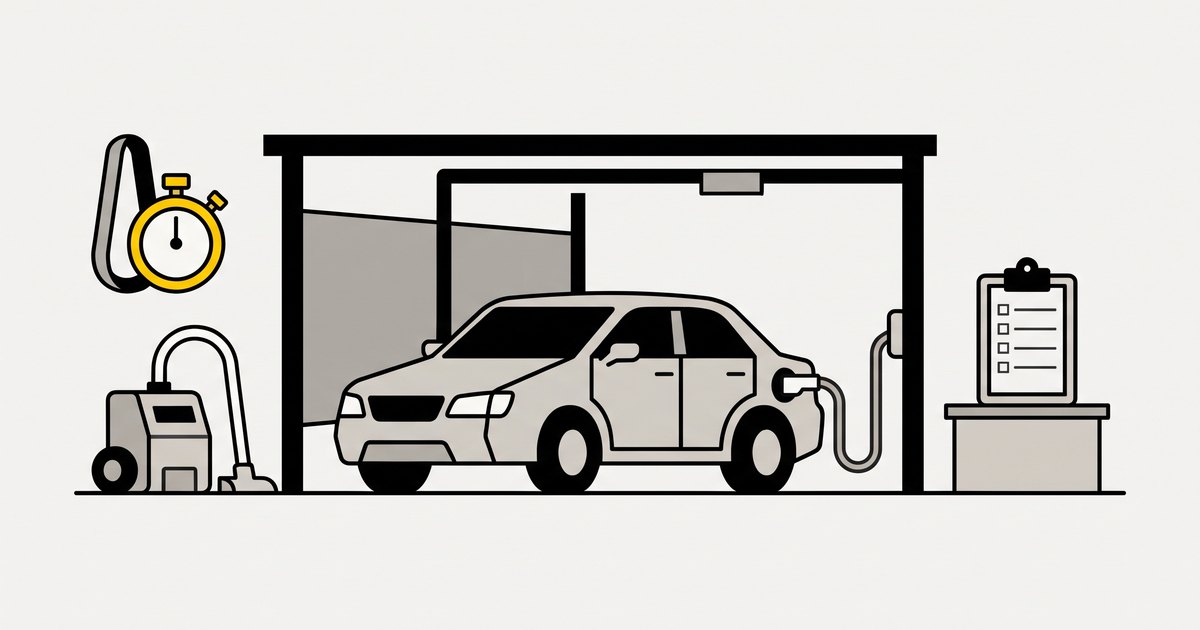
Short answer: Rental car turnaround time is the time from the moment a car comes back to the moment it is ready for the next renter. For a standard car on a routine clean, our standard is 60 minutes of work in nine timed steps: check in, empty, clean inside, wash, dry, restock, refuel or plug in, check recalls and service, then a final check before you mark it ready. Time every turnaround for two weeks and compare against the targets below; the gaps show you where the hour goes.
Most turnaround advice is a cleaning list with no clock on it. A clock is what turns cleaning into capacity: a car that is ready at 11:00 instead of 14:00 can go out again the same day. This guide gives you a timed standard, the US open-recall rule that belongs inside every turnaround, charge targets for electric cars and a printable checklist. The minute targets are our assumptions for a single attendant with a hose, a vacuum and a charger on site. Replace them with your own times after two weeks of measuring.
General information, not legal advice. Recall and safety duties differ by country and fleet size; check with your lawyer if you are unsure which apply to you.
Key takeaways
- Measure two numbers: touch time (minutes of work) and elapsed time (return to ready, including waiting). Elapsed time is what costs you rentals.
- A routine turnaround should take about an hour of work. An express turnaround on a clean short-rental return can take half that; a smoke or pet clean takes the car off rent.
- The recall check is part of the turnaround. In the US a rental company with 35 or more rental cars may not rent one with an open safety recall until it is fixed.
- EVs need a charge plan, not just a plug. A Level 2 charger adds roughly 25 miles of range per hour, so a short turnaround cannot rescue a nearly empty battery.
- Write the standard down and time it. What gets timed gets faster.
The timed turnaround standard
Targets are for a compact or midsize car after a rental of a few days (our assumptions).
| Step | What it covers | Target touch time | Common delay |
|---|---|---|---|
| 1. Check in | Return time, odometer, fuel or charge, return photos, new damage noted | 8 min | Renter still at the counter with questions |
| 2. Empty | Belongings, trash, floor mats out | 3 min | Lost-property logging |
| 3. Clean inside | Vacuum, wipe touch points, screens, glass inside | 15 min | Sand, pet hair, spills |
| 4. Wash outside | Wash or rinse body, wheels, glass outside | 10 min | Queue at the wash bay |
| 5. Dry | Body, mirrors, door shuts, mats back in | 4 min | Cold or wet weather |
| 6. Restock | Cables, child seat, ice scraper, agreement wallet, toll tag | 3 min | Missing items not reported |
| 7. Fuel or charge | Refuel to full, or plug in and check the charge plan | 10 min gas, 2 min EV | Drive to the gas station |
| 8. Recall and service check | Open recalls by VIN, service due, warning lights, tires | 3 min | Recall found: car stays off rent |
| 9. Final check and ready | Walk-around, smell test, keys, status set to ready | 4 min | Waiting for a supervisor |
| Total | 60 min gas, 52 min EV |
Two variants are worth writing down as well:
- Express (about 30 minutes): a car back from a one- or two-day rental, visibly clean. Skip the full wash and interior vacuum; keep check-in, touch-point wipe, restock, fuel or charge, recall and service check, and the final check.
- Deep clean (90 to 120 minutes, our assumption): smoke, pets, heavy sand or a spill. The car is off rent until it passes the smell test, and the cleaning fee in your agreement applies.
Step by step: what good looks like
1. Check in
Record the return time, odometer and fuel or charge level, take the return photos and note anything new. The full photo standard is in our inspection checklist; for turnaround purposes the rule is simple: never start cleaning before the return record is saved, because cleaning removes evidence.
2 and 3. Empty and clean inside
Work top to bottom and front to back so dust falls onto areas you have not cleaned yet. Spend the most time on what the next renter touches: steering wheel, gear selector, door handles, seat belt buckles, window switches, the infotainment screen and the key or fob. Check under the seats and in the door pockets for belongings, and log anything you find against the rental.
4 and 5. Wash and dry
A full hand wash on every return is rarely worth the time. Rinse the body, wheels and glass, and do a full wash on a schedule (weekly, for example) or when the car comes back visibly dirty. Drying matters more than it looks: water marks on glass and mirrors are the first thing a renter notices at pickup.
6. Restock
Keep a short list per car: charging cable for an EV, child seat if booked, ice scraper in winter, the agreement wallet, the toll tag. A missing cable discovered at pickup costs more time than the whole restock step.
7. Fuel or charge
For gas cars, a fuel station trip is often the longest single step. If you refuel on site or in batches, the target drops to a few minutes. For EVs, plugging in takes two minutes; the charge itself is a scheduling problem, covered below.
8. Recall and service check
Run the car's VIN through NHTSA's recall lookup in the US, or the DVSA vehicle recall checker on GOV.UK in Britain. Then check the service due date or mileage, warning lights and tire condition. If anything fails, the car goes off rent and into your maintenance queue; our maintenance scheduling guide covers the intervals.
9. Final check and ready
Walk around the car once more, open a door and smell the cabin, check the keys and set the car to ready in your system. "Ready" should mean ready: anyone should be able to hand the car to a renter without looking at it first.
The open-recall rule in the US
Since the FAST Act of 2015, federal law has barred rental companies from renting out vehicles under an open safety recall. Under 49 U.S.C. 30120(i), once a rental company receives a recall notice for a covered rental vehicle, it may not rent the vehicle until the defect is remedied, and it must comply as soon as practicable and no later than 24 hours after receiving the notice (48 hours if the notice covers more than 5,000 of its vehicles). Where the remedy is not yet available but the notice describes an interim fix, the car may be rented once that fix is done.
The law defines a rental company as one using a fleet of 35 or more covered rental vehicles on average during the calendar year, and a covered rental vehicle as one of 10,000 pounds or less rented without a driver for an initial term of under four months. In October 2023 NHTSA announced a $300,000 consent order with Zipcar, its first enforcement action against a rental company over unrepaired recalls. Smaller fleets are outside the federal definition, but renting a car you know has a safety defect is a liability risk anywhere, so check every car.
Electric cars: charge targets that fit a turnaround
The US Department of Energy's Alternative Fuels Data Center puts Level 2 charging at about 25 miles of range per hour and DC fast charging at about 100 to 200+ miles per 30 minutes, with charging power varying by vehicle and battery state of charge. That is why a turnaround standard for EVs needs two numbers (our assumptions):
- Handover target: at least 80% for a rental of a day or more, and at least 60% for an hourly or local rental.
- Return floor: the minimum charge in your agreement, for example 20%, with a recharge fee below it. Our guide to EV charging policies and fees covers the wording.
Worked example: can this EV go out again in an hour?
An EV with about 250 miles of range comes back at 40% (our assumptions). Reaching the 80% handover target means adding about 100 miles of range.
| Charger | Time to add 100 miles | Fits a 60-minute turnaround? |
|---|---|---|
| Level 2 at about 25 miles per hour | About 4 hours | No |
| DC fast at 100 to 200+ miles per 30 minutes | About 15 to 30 minutes | Yes, if a charger is free |
Without a fast charger on site, the honest answer is to plan the next booking on that car for later in the day, or to give it to a renter with a short local trip.
What the clock is worth: a fleet example
A 20-car fleet averages three returns per car per week, and its elapsed turnaround is three hours because cars wait for an attendant (our assumptions). Cutting elapsed time to one hour frees two hours per return:
- 20 cars × 3 returns × 2 hours = 120 car-hours a week, or five car-days.
- Those hours only earn money if a renter wants the car that day, so look at how often you turned down same-day bookings or sent a renter a different class.
Track turnaround alongside utilization in your KPI dashboard. If utilization is high and same-day refusals are common, turnaround is one of the cheapest places to find capacity. If utilization is low, put the effort into bookings instead.
The printable turnaround checklist
- Return time, odometer and fuel or charge recorded; return photos saved
- New damage noted; car held if anything is safety-critical
- Belongings and trash removed; lost property logged
- Interior vacuumed; touch points, screens and glass wiped
- Smell test passed; smoke, pet or spill flagged for a deep clean and the cleaning fee
- Body, wheels and glass rinsed or washed; mirrors and door shuts dried
- Mats back in; cables, child seat, scraper, toll tag and agreement wallet restocked
- Fuel full, or EV plugged in with the handover target and time noted
- VIN checked for open recalls; date recorded
- Service due, warning lights and tires checked
- Keys present and counted
- Final walk-around done; car set to ready, with the time
Print one per car and write the finish time next to each step for the first two weeks. After that, a spot check of one turnaround a day keeps the standard honest.
Where CarCEO fits
CarCEO covers the parts of the turnaround that are records rather than elbow grease. The return flow records the return time, odometer and fuel, with check-in photos and a printable comparison against the pickup inspection. Charges at return are yours to decide: the inspection never adds them on its own, and a cleaning fee goes on the invoice as its own line when you add it.
Maintenance can be scheduled by kilometers or miles, engine hours or days, and maintenance-due alerts by email and WhatsApp are on by default. Registration, insurance and inspection expiry reminders appear in the app, and you can choose to block rentals of a car with an expired document. CarCEO does not check recalls for you, so keep the VIN lookup on your checklist.
Keep reading: the pickup and return inspection checklist and fleet utilization: the formula and the benchmarks.
FAQ
What is a good turnaround time for a rental car?
About an hour of work for a routine clean on a standard car, and around 30 minutes for an express turnaround on a clean short-rental return, by our standard. What matters more is elapsed time, from return to ready, which includes waiting. Measure both for two weeks before you set targets.
How long does it take to clean a rental car between rentals?
The interior clean, wash and dry take about 30 minutes together in our standard. A deep clean for smoke, pets or sand takes 90 minutes or more, and the car should stay off rent until it passes a smell test.
Do I have to check for recalls before every rental?
In the US, rental companies with fleets of 35 or more covered rental vehicles may not rent a car with an open safety recall until it is fixed, and must act within 24 hours of receiving a notice. Smaller operators are outside that definition, but checking the VIN on every turnaround is the safe habit everywhere.
What charge level should an EV have when it goes out?
Our assumption is at least 80% for rentals of a day or more and 60% for short local rentals. Set a minimum return charge in your agreement, so that cars come back with enough battery to be turned around on a Level 2 charger.
Should I charge a cleaning fee?
Only if your agreement says when it applies and how much it is, and only for cleaning beyond normal use, such as smoke, pet hair or heavy soiling. Take photos at return before you start cleaning, so you can show the renter why the fee was charged.
Turn cars around with the return record, photos and maintenance alerts in one place: start free with CarCEO, or see the plans.