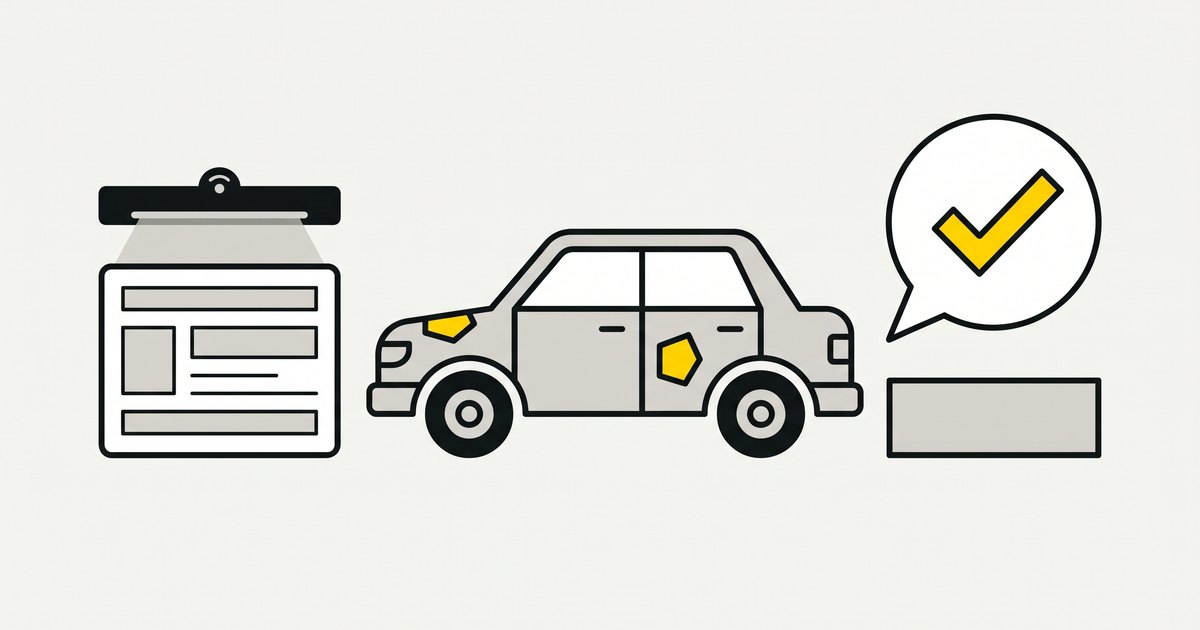
Short answer: For a 10 to 50 car rental operator, AI in 2027 is useful in four places: reading documents such as licenses, ID cards, registration papers and old paper contracts; suggesting where the damage is in inspection photos; drafting or sending routine replies to renters; and answering simple booking questions on your website. Staff should confirm every document reading and damage suggestion before it is saved, and a booking assistant should only quote and book at your real prices and live availability. AI should not set your prices or decide on its own who may rent, and if a chatbot talks to renters in the EU, the AI Act has required since 2 August 2026 that they are told it is an AI.
Most writing about AI in car rental is about the airport giants. This guide is for the independent operator: what is worth automating now, what it really saves, how it fails, and the AI Act rule most likely to affect anyone serving European renters.
General information, not legal advice. Rules on AI and personal data vary by country; check with your lawyer before you rely on an automated system for decisions about customers.
Key takeaways
- Document reading is the safest win. It removes typing, not judgment, and a person can check every field against the card in hand.
- Damage detection is a second pair of eyes, not an inspector. It misses small chips and mistakes dirt and reflections for damage.
- Chat assistants save evenings and weekends, but only with written policies, hard limits and a clear hand-off to a person.
- Keep AI away from your rate card. A model sees bookings, not your cost per car, your insurance bill or the festival in town next month.
- EU renters must be told they are talking to an AI under Article 50 of the AI Act, in force since 2 August 2026.
What a small fleet can automate in 2027
| Task | What AI does well | Where it goes wrong | The human step | Worth it at 10–50 cars? |
|---|---|---|---|---|
| Reading licenses and ID cards | Fills name, number and dates in seconds | Glare, worn cards, day and month order | Compare with the card in hand | Yes |
| Registration papers and VINs | Fills vehicle records in batches | Confuses 0 and O, 8 and B | Check the VIN on the car | Yes, at setup and when buying |
| Old paper contracts | Turns a filing box into records | Handwriting, crossed-out amounts | Check every money field | Once, when you switch systems |
| Damage photos | Suggests where damage is and how bad | Reflections, rain, dirt, low light; small chips missed | Staff confirm every mark | Yes, as a second opinion |
| Replies and website chat | Answers routine questions at any hour | Invents a policy, quotes a wrong price | Limits plus hand-off to staff | Yes, with limits and disclosure |
| Fine and toll notices | Reads the notice and finds the rental | Wrong date or plate match | Check before you charge | Yes, if you get many |
| Setting rates | Spots booking patterns | Cannot see costs or local events | You set the rates | Not yet |
Document reading: the safest win
Typing a license number, a date of birth and an address takes a few minutes per rental and invites typos. AI reading turns that into a check: the fields fill themselves and a staff member confirms them while the renter and the document are still in front of them.
The errors change shape rather than disappear. Watch for day and month swapped on documents from other countries, the issue date read as the expiry date, missing middle names and the wrong license class. The rule that keeps you safe is simple: AI fills, a person confirms, and nothing is saved unchecked.
Registration papers and VINs work the same way and matter most when you add cars or move to a new system. A single wrong character in a VIN breaks recall checks and insurance matching later. If you are moving years of paper contracts into software, our guide to digitizing paper rental contracts covers the triage order and the checks.
Damage photos: suggestions, not decisions
Vision models are now good at pointing at a dent or a long scratch on a clean, well-lit panel. They are poor at the conditions rental lots actually have: rain on the paint, low winter light, a dusty car, reflections of other cars, wheels and the interior. They also miss small chips, which are exactly the marks renters argue about.
Use AI to suggest marks on the diagram, then have the staff member doing the inspection confirm, move or delete each one. The evidence that wins a damage dispute has not changed: timestamped photos from the same angles at pickup and return, a signed inspection, and a repair cost from a real quote. A charge based on a suggestion nobody checked is the kind that loses a card dispute. Never let a model price a repair.
Replies and chat assistants
An assistant on your website or messaging channel can answer the questions you answer twenty times a week: opening hours, documents needed, the deposit amount, minimum age, directions to the pickup point, whether a car is free next weekend. It can also draft replies for staff to send.
The risks are specific. It may invent a policy ("yes, free cancellation"), quote a price that does not exist, promise a car that is already out, or try to settle a complaint it should not touch. Set it up the boring way:
- Give it your written policies and prices, and nothing else to improvise from.
- Limit what it may promise: no refunds, no damage decisions, no exceptions.
- Send complaints, damage, accidents and payment problems to a person.
- Read a sample of conversations every week and fix what it got wrong.
Pricing: why we would not hand rates to a model
A model can see which dates book quickly. It cannot see that one car costs you twice as much to insure, that a concert is coming, that half the fleet is due for brakes, or that you promised a corporate client a rate. Prices that change for reasons nobody can explain are also hard to defend to renters.
Rule-based demand pricing is the safer middle ground: rates move with utilization and booking lead time inside limits you set, and every change shows its reason. Our dynamic pricing guide covers how to build those rules.
What it saves: a worked example
A 25-car operator with 70 rentals a month. Every figure below is our assumption, not a benchmark:
| Line | Monthly figure |
|---|---|
| Typing license and ID details avoided (70 rentals × 4 minutes) | 4.7 hours |
| Damage marking sped up (140 inspections × 3 minutes) | 7.0 hours |
| Routine replies answered or drafted (20 minutes × 30 days) | 10.0 hours |
| Time added checking AI output (70 rentals × 1.5 minutes) | −1.8 hours |
| Net time saved | about 20 hours |
| Value at $22 an hour of staff time | about $438 |
That is real but modest, and it assumes the checking actually happens. The bigger gains are harder to price: fewer typos in contracts, faster check-ins on a busy Friday, and questions answered at 11 p.m. instead of lost to a competitor. The bigger cost is the error you did not catch. One wrongful damage charge that turns into a dispute can wipe out a month of saved hours.
Failure cases to plan for
- A misread expiry date lets an expired license through. Staff confirm dates against the physical card, every time.
- The assistant invents a policy. Written policies, hard limits and a hand-off to a person; review transcripts weekly.
- Dirt is read as a scratch and the renter is charged. A person confirms every mark, and you compare pickup and return photos before any charge.
- One bad photo hides real damage. Fix the photo routine: same angles, enough light, close-ups of anything doubtful.
- The AI service is slow, down or over its daily limit on your busiest day. Make sure manual entry always works and staff know how to use it.
- Personal data goes somewhere you did not expect. Read your software provider's data terms, keep only the documents you need, and delete on schedule.
- A machine refuses a renter. Data-protection law in the EU and the UK sets rules for decisions made solely by automated means that significantly affect a person. Keep a person in the loop for every refusal.
The EU AI Act: tell renters they are talking to an AI
Article 50 of the AI Act (Regulation (EU) 2024/1689) has applied since 2 August 2026. AI systems meant to interact directly with people must be designed so those people are informed that they are dealing with an AI, unless that is obvious, and the information must be given clearly at the latest at the first interaction. Summaries of the 2026 amending regulation agree that it delayed the high-risk rules, not this duty; check the current text if you are unsure.
The legal duty sits mainly with the provider that builds the system, but it speaks for your business, so check how it introduces itself. If any assistant answers EU renters for you, make sure the conversation opens with a plain line such as "This is an automated assistant for Carter Car Rental; a person will follow up on anything it cannot answer", and do the same for automated WhatsApp replies.
A 30-day plan to try AI safely
- Week 1: time your current check-in and booking admin, so you have a before.
- Week 1: switch on document reading only, and log every field staff correct.
- Week 2: add damage suggestions on check-in photos, and compare them with what staff mark on their own.
- Week 3: write down your policies, prices and hand-off rules for any assistant.
- Week 4: only then put an assistant in front of renters, with disclosure, limits and weekly transcript reviews.
How CarCEO uses AI
CarCEO's AI features run on Google's Gemini models. Our AI car rental software page shows them in more detail. What they do, with their limits:
- Documents: paper contract import, batch scanning of up to 20 registration cards, and ID and license reading into the customer record.
- Inspections: AI vehicle diagrams, capped at 30 a day per business, and damage suggestions from photos. A suggestion writes nothing until a staff member confirms or edits it, and repair costs are never filled in by AI.
- Assistants: an in-app assistant for staff, and a website assistant for renters that is on by default when your booking website is live. It quotes only from your price list and live availability, can create a booking and send a payment link, and when it cannot help it passes the visitor's details to your quotes list. You can switch it off in Website settings. If you serve EU customers, check how any assistant on your website identifies itself, ours included. Automated WhatsApp replies are a separate setting and are off unless you turn them on.
- Daily limits: AI use is capped per business per day by plan: 50 calls on Starter, 300 on Office, 1,000 on Ultimate and 3,000 on Enterprise.
No AI sets your prices. Demand pricing is optional, off by default, follows rules based on utilization and booking lead time, and shows the reason for every change.
Keep reading: the 2027 car rental regulations tracker and the 90-day car rental marketing plan.
FAQ
How is AI used in the car rental industry?
For independent operators, mainly to read documents, suggest damage marks from inspection photos, draft or send routine replies and answer booking questions on a website. In every use, a person should check the output before it affects money or a renter.
Can AI detect damage on rental cars?
It can suggest likely damage on clear, well-lit photos and save time marking a diagram. It misses small chips and is fooled by dirt, rain and reflections, so a staff member should confirm every mark and no charge should rest on an unchecked suggestion.
Do I have to tell renters they are chatting with an AI?
In the EU, yes: Article 50 of the AI Act has required since 2 August 2026 that people are informed when they interact with an AI system, unless it is obvious. Elsewhere it is still the honest default and avoids complaints. Put a plain line at the start of every automated conversation.
Should I let AI set my rental prices?
Not on its own. A model cannot see your cost per car, insurance, maintenance plans or local events, and unexplained price changes are hard to defend. Use cost-based rates plus rule-based adjustments you can explain.
Is it safe to upload driver's licenses to an AI tool?
Only if you know where the data goes and how long it is kept. Check the provider's data terms, keep only what you need for the rental and your legal duties, and delete documents on a schedule.
Try document reading, damage suggestions and a booking website on your own fleet: start free with CarCEO, or see the plans.